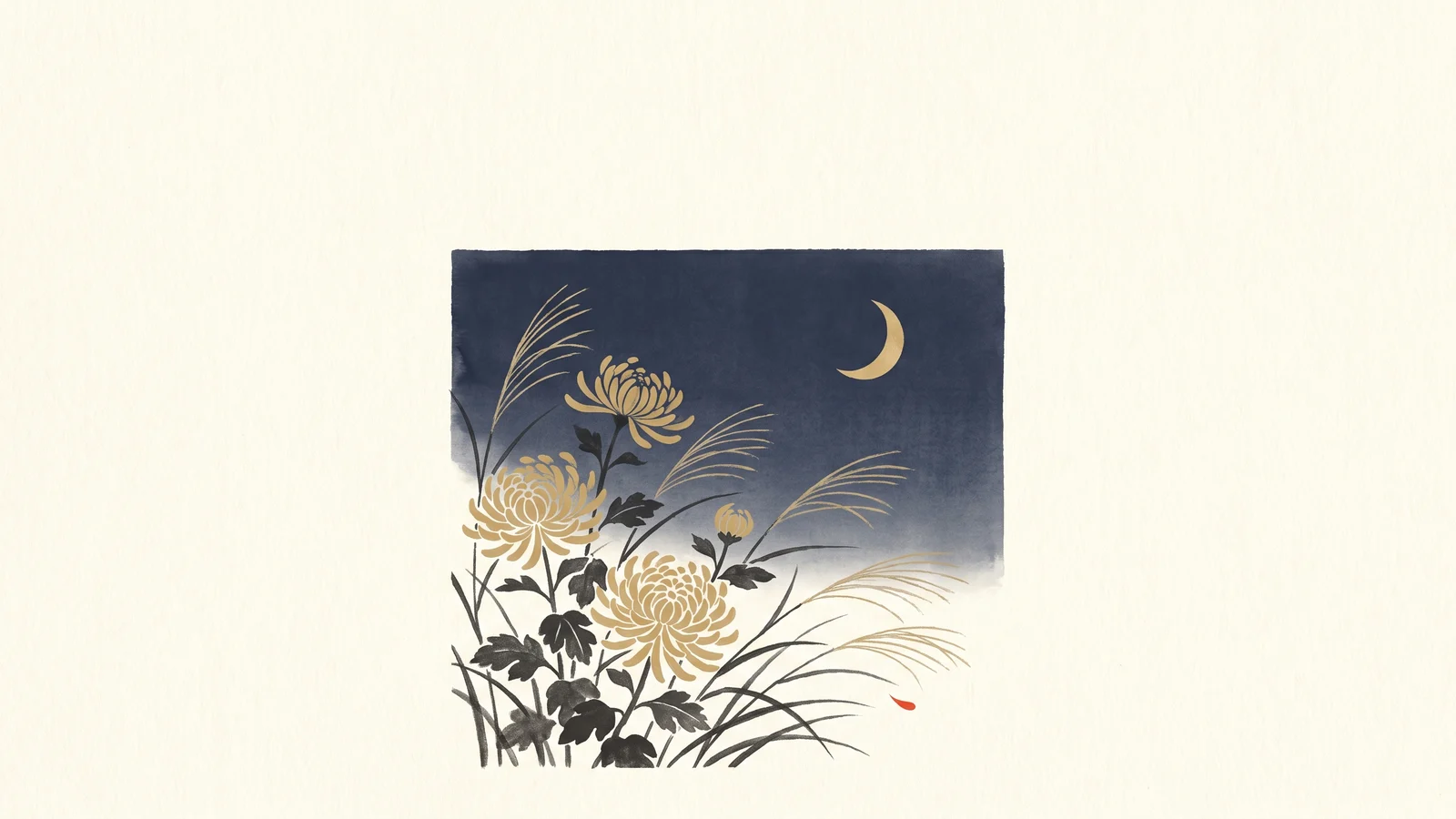
September is an in-between month. Japan National Tourism Organization’s September guide describes the month as one of the nominal autumn months while noting that much of Japan can still feel hot; it also flags typhoons as most frequent from late August through much of September. That is the right opening note for this edition: September is not a single mood. It is late beach weather in some places, early foliage in parts of Hokkaido, festival season in scattered cities, and a gradual return to school and work after summer.
For Japan Almanac, September 2026 has three anchors.
The first is Choyo no Sekku on September 9. Kokugakuin University’s Encyclopedia of Shinto identifies Choyo as the Chrysanthemum Festival, traditionally held on the ninth day of the ninth month and associated with chrysanthemums, longevity, and chrysanthemum-petal wine. The date matters here because September is also the chrysanthemum suit in Hanafuda.
The second is Japan’s 2026 holiday sequence. The Cabinet Office lists Respect for the Aged Day on September 21, a holiday under Article 3 paragraph 3 on September 22, and Autumnal Equinox Day on September 23. Japan Almanac is not a travel-deal site, so the editorial point is not merely “long weekend.” The dates show how an astronomical season marker, a civic holiday, and a legal bridge day can shape the lived calendar.
The third is Chushu no Meigetsu, the mid-autumn moon. The National Astronomical Observatory of Japan places the 2026 Chushu no Meigetsu on September 25 and notes that the astronomical full moon occurs on September 27 at 01:49 Japan Standard Time. That two-day separation is a useful reminder: traditional observance dates and astronomical full-moon instants can be related without being identical.
This Month’s Hanafuda Lens
Hanafuda’s September suit is chrysanthemum. In the Koi-Koi deck used by this site, the four cards are:
- Sake cup, treated in Koi-Koi as an animal/object card.
- Blue ribbon.
- Chrysanthemum chaff card.
- Chrysanthemum chaff card.
Nintendo Museum summarizes the deck structure this way: Hanafuda uses flowering plants associated with the seasons, with four cards for each month from January through December, making 48 cards. Japan Almanac uses that structure as a calendar framework, while making sure that card-game rules, historical symbolism, and current dates are not flattened into one story.
How We Know
This edition uses institutional sources for each type of claim: JNTO for seasonal travel framing, the Cabinet Office for public holidays, NAOJ for moon dates, Kokugakuin University for Choyo no Sekku, and Nintendo Museum for the deck structure. Koi-Koi’s own repository is used only for the exact internal card assets and current app/rules status, not as a substitute for external cultural sources.
Sources
- Japan in September, Japan National Tourism Organization. Accessed 2026-09-01. Used for seasonal travel/weather framing and September festival context.
- National Holidays for 2026 and 2027, Cabinet Office, Government of Japan. Accessed 2026-09-01. Used for Japan's September 2026 public holidays and holiday-law notes.
- Chushu no Meigetsu, September 2026, National Astronomical Observatory of Japan. Accessed 2026-09-01. Used for the 2026 date of Chushu no Meigetsu and the full-moon timing.
- Choyo, Kokugakuin University Digital Museum, Encyclopedia of Shinto. Accessed 2026-09-01. Used for Choyo no Sekku, chrysanthemum wine, and festival history.
- Try Playing Hanafuda!, Nintendo Museum. Accessed 2026-09-01. Used for the 48-card, 12-month Hanafuda structure and Nintendo Museum workshop context.
Corrections
See something that needs review? Use the contact route listed on the corrections page; update notes are published with the article when a material change is made.
Correction policy